
Model shows solar geoengineering may be surprisingly effective in alleviating impacts of global warming on crops
Research offers better understanding of solar geoengineering’s effect on agriculture.
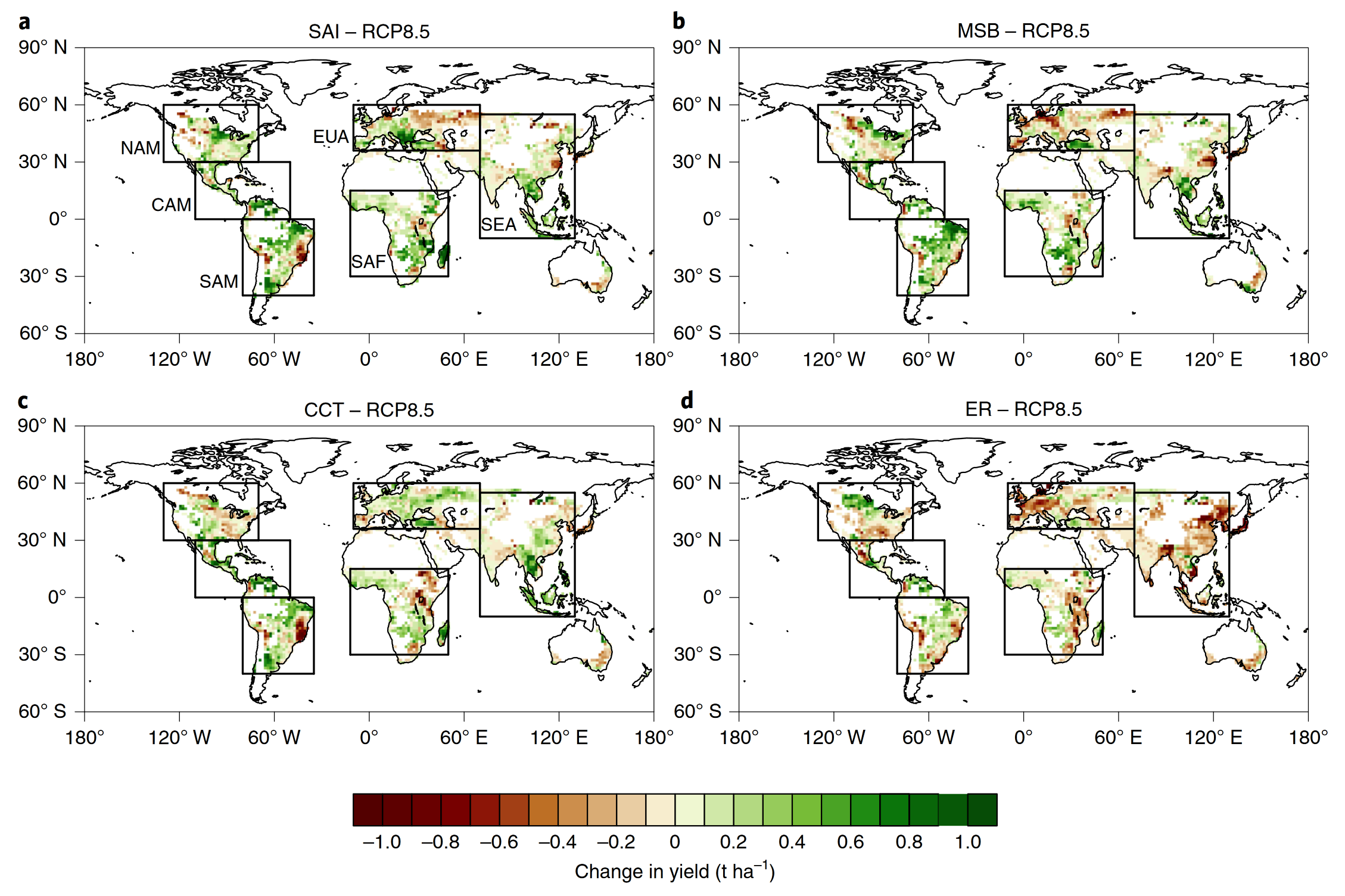
Solar geoengineering — putting aerosols into the atmosphere to reflect sunlight and reduce global warming — is not a fix-all for climate change but it could be one of several tools to manage climate risks.
Research from the Harvard John A. Paulson School of Engineering and Applied Sciences finds that solar geoengineering may be surprisingly effective in alleviating some of the worst impacts of global warming on crops.
The research, a collaboration with the Norwegian Research Centre and the Bjerknes Centre for Climate Research, the Norwegian University of Science and Technology, the National Center for Atmospheric Research, Seoul National University, and the Chinese Academy of Sciences, is published in Nature Food.
“Research on solar geoengineering must address whether or not it is effective at reducing human impacts of climate change. Our paper helps fill that gap by using the best crop model yet embedded in a climate model to examine the potential impact of solar geoengineering on agricultural yields.”
The team looked at three types of solar geoengineering — stratospheric aerosol injection, marine sky brightening, and cirrus cloud thinning — and their impact on the global yield of maize, sugarcane, wheat, rice, soy, and cotton.
In such a future, the most effective way to protect crops against the worst effects of global climate change is to reduce the surface temperature. The researchers found that all three potential methods have a strong cooling effect that would benefit crop yields.
“Relative humidity or vapor pressure deficit has stronger control on plant water use and crop productivity than precipitation. Our model shows that the change in precipitation resulting from all three solar geoengineering methods would, in fact, have very little effect on crops.”
Climate risks cannot be resolved with any single tool
The study highlights the need to combine emissions reductions with other tools, including local adaptation, carbon removal, and potentially solar geoengineering, to reduce climate risks.
The research was co-authored by Jerry Tjiputra, Helene Muri, Danica Lombardozzi, Chang-Eui Park, and Shengjun Wu. The research was supported in part by Harvard University’s Solar Geoengineering Research Program.