
Global drought shows no detectable recent acceleration under climate warming
A collaborative study led by Yuanchao Fan at Tsinghua SIGS finds no statistically significant recent acceleration of global drought over 1981–2024.
Drought is a major climate hazard threatening global water security, ecosystem stability, and food production. Under continued global warming, some studies have suggested that terrestrial drying is not only intensifying but may also be accelerating. However, global drought assessments typically rely on meteorological drought indices such as the Standardized Precipitation Evapotranspiration Index (SPEI), which are highly sensitive to how potential evapotranspiration (PET) is computed. A systematic evaluation of how different PET methods affect global drought trends and their acceleration characteristics has been lacking.
To address this gap, the team combined multiple global meteorological and precipitation datasets for 1981–2024 with six widely used PET methods to construct 11 independent global SPEI datasets. They systematically compared SPEI changes computed with Penman-type versus energy-limited PET, assessed global drought trends in terms of intensity, affected area, frequency, and duration, and tested for significant acceleration using sliding time windows and statistical tests accounting for temporal autocorrelation. The analysis was further extended to long-term climate records back to 1950 and 1901.
The results show that the global mean SPEI drying trend for 1981–2024 estimated with energy-limited methods (−0.0014 yr⁻¹) is about 83% lower than that from Penman-type methods (−0.0084 yr⁻¹) — a roughly sixfold difference in drying magnitude. The drought-area expansion rate from Penman-type methods is about eight times that of energy-limited methods. Spatially, about 44.4% of quasi-global land shows significant drying under Penman-type PET, versus only 26.8% under energy-limited PET, indicating that a substantial share of previously reported “global drying” signals actually stems from the choice of PET method.
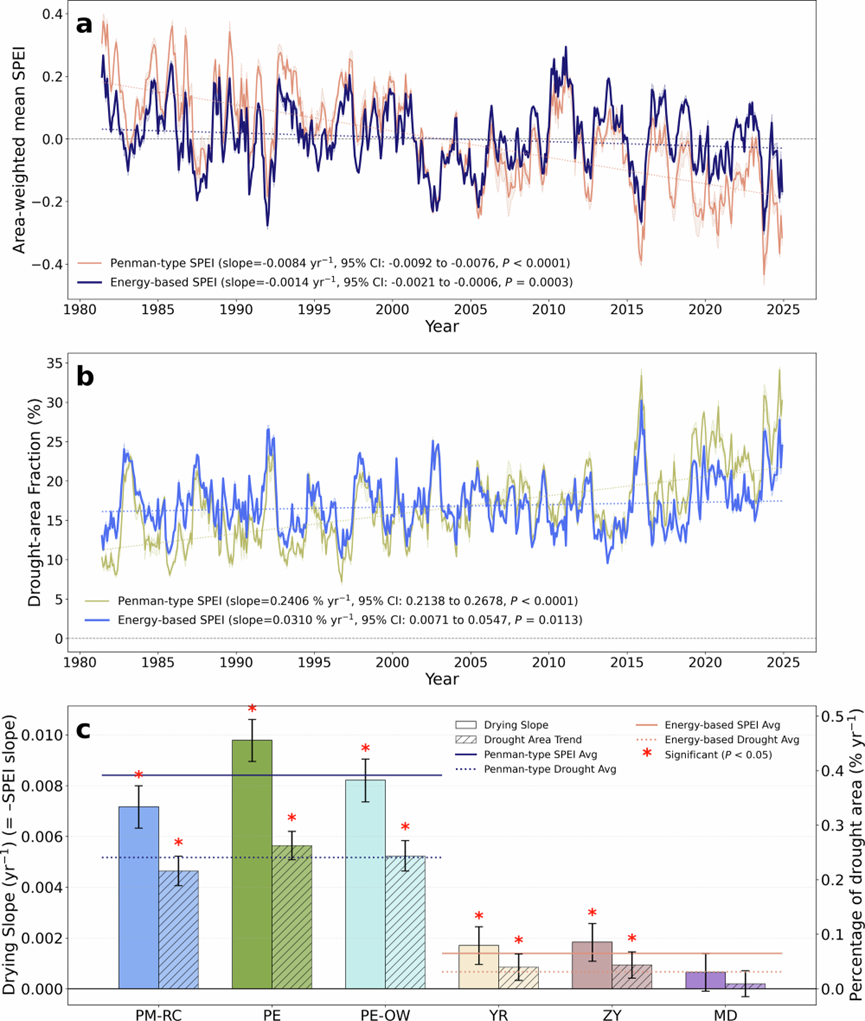
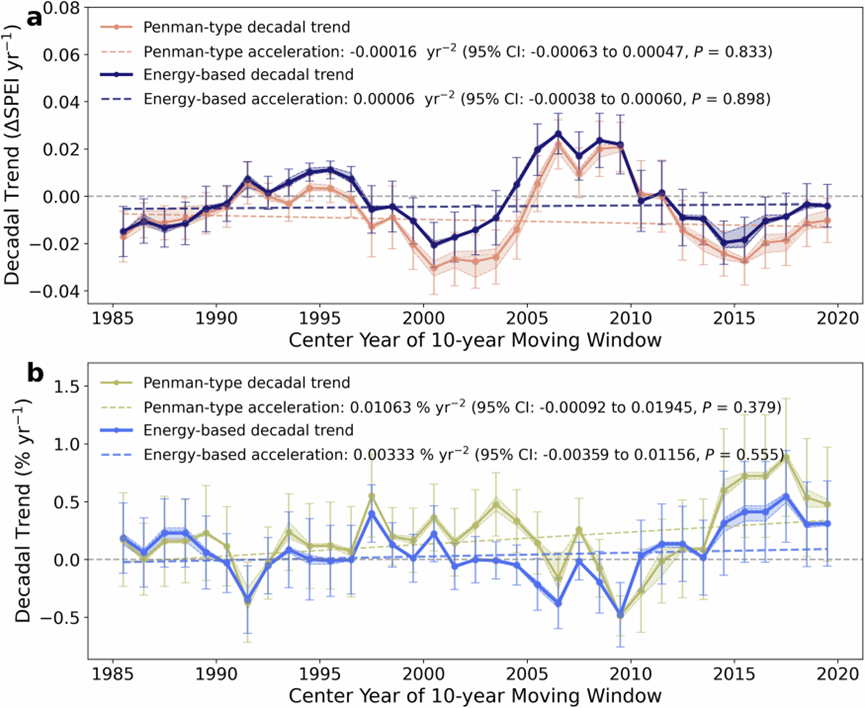
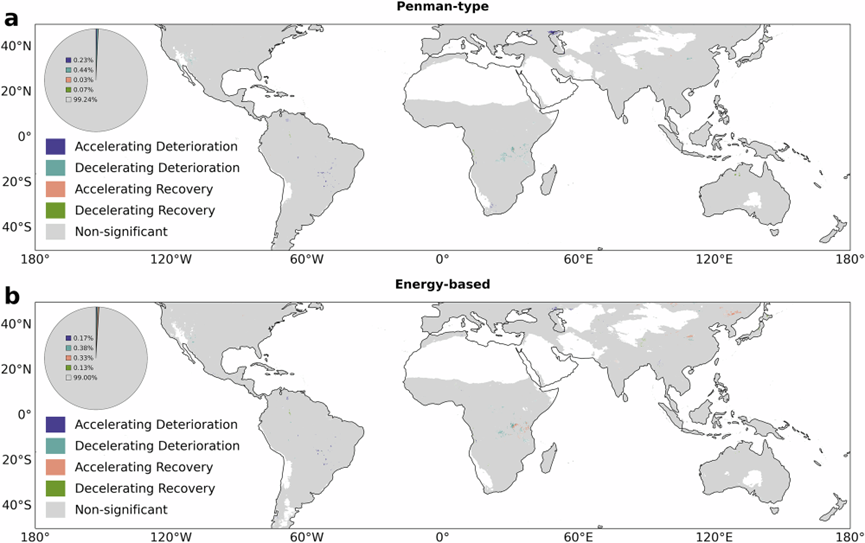
Consecutive 10-year sliding-window tests further show that neither Penman-type nor energy-limited PET yields statistically significant persistent acceleration of global mean drought intensity or affected area during 1981–2024. Spatially, roughly 99% of quasi-global land shows no significant acceleration or deceleration of drought under either PET method. Validation with the longer 1950–2024 and 1901–2024 records likewise detects no significant acceleration or deceleration.
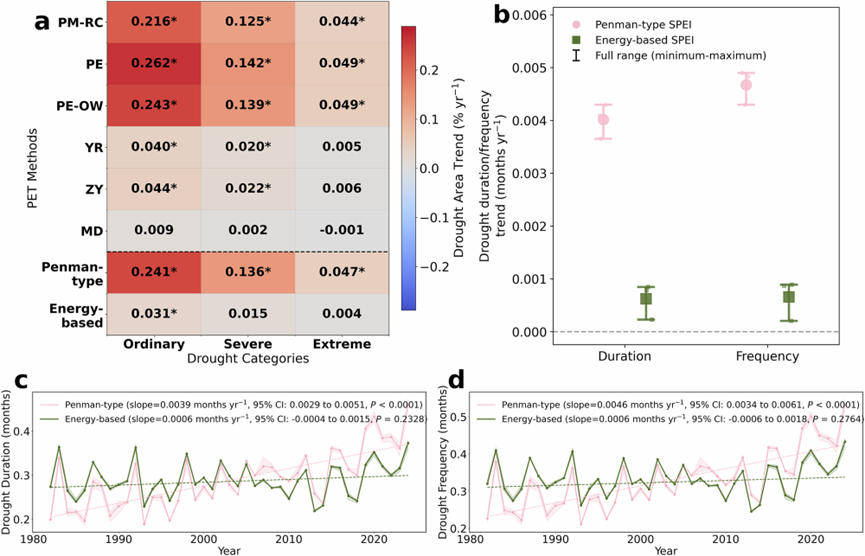
The PET-method differences extend broadly across moderate (SPEI < −1), severe (SPEI < −1.4), and extreme (SPEI < −1.8) drought categories, as well as drought duration and frequency. Penman-type methods generally yield stronger increases in drought area, duration, and frequency, while energy-limited methods produce markedly weaker changes.
Further analysis shows that the two method families differ fundamentally in their treatment of land–atmosphere interactions. Penman-type methods treat near-surface temperature, humidity, and vapor pressure deficit as key drivers of evaporative demand, but these variables are themselves affected by soil drying and changing actual evapotranspiration. Ignoring this land–atmosphere feedback can recast drought-induced atmospheric drying as an external driver of rising PET, amplifying long-term drought trends. Energy-limited methods, by contrast, are more strongly constrained by available surface energy and land–atmosphere coupling. Attribution results show that under the energy-limited framework, precipitation changes explain about 75% of the long-term drought trend.
Intensifying drought in some regions remains a real and important climate risk, but “long-term drying” must be distinguished from “persistently accelerating drying”.
The study re-examines global drought change and its purported acceleration under climate warming, emphasizing that climate impact assessments must account not only for data uncertainty but also for the physical assumptions and statistical frameworks embedded in drought indices themselves. Future work should integrate direct ecohydrological observations and coupled Earth system models to improve the physical consistency of drought monitoring and risk assessment, providing more reliable scientific support for water management, agricultural production, and climate adaptation.
The study, titled “Global drought shows no detectable recent acceleration under climate warming,” was published in Communications Earth & Environment on September 11. The first authors are postdoctoral researchers Jiameng Xu and Xiao Zhang of Tsinghua SIGS, and the corresponding author is Associate Professor Yuanchao Fan of Tsinghua SIGS. Co-authors include Associate Professor Kaighin A. McColl of Harvard University, Assistant Professor Alexis Berg of Université de Montréal, Researcher Sha Zhou of Beijing Normal University, Associate Professor Jian Yang of the University of Kentucky, and Ph.D. students Zhaoyu Dong and Yuanyuan Luo of Tsinghua SIGS.